The Roar of Raung (Part 6)
Every mountain has a story — not only of eruptions and rocks but of names, meanings, and memories that live among the people who see it every day. When the Land Rose Again After ancient eruptions covered the valleys and filled the basins with sediments, the land seemed to grow quiet. But beneath the surface, something was still alive — pressure, magma, and movement were preparing for another rise. From this process, a new formation appeared — Mount Pegge, a name given by local people who saw the shape and said it looked “peggé,” or bulging from the ground. Local names like this are not random; they reflect how people understood and felt their land. Then came Mount Raung, rising higher than the rest. Unlike other volcanoes, Raung stood upon the “basement” of older mountains — Suket, Pendil, and Jampit. It grew by building upon what already existed. That is…
The Civilization Beneath the Volcano (Part 5)
As we step into the next era after the great volcanic eruptions, the stones that once told stories of fire and creation now whisper about human civilization — how people adapted, believed, and built their world upon ancient landscapes.Bondowoso, as it turns out, preserves one of the most complete chains of civilization in East Java — from the Megalithic, Classic, Colonial, to the Modern era we live in today. The Megalithic Legacy The Megalithic period in Bondowoso is visible everywhere — through the countless sarcophagi, dolmen, kenong stones, and cylindrical stones scattered across its land.Visit Grujugan or Pusat Informasi Majapahit (PIM) Museum in Bondowoso, and you’ll find these artifacts still standing, not as told in the classroom, but in their original soil — allowing visitors to touch history, to sense the craftsmanship carved by ancient hands. These stones, locally known as Megalithic sites, hold more than archaeological value — they are…
The Living Landscape: Geotourism, Hot Springs, and Coffee Farms of Ijen (Part 4)
Every stone tells a story — alive, ancient, and filled with memory. In Ijen, the rocks are not silent. They speak of time, eruption, and rebirth.If these stones are mined or destroyed, we might gain money, but we lose their stories forever. That is why the concept of Geotourism is so important. It allows us to conserve while earning, turning stories into shared value. The Ijen Geopark embodies this philosophy. Its foundation lies in scientific research — studies by geologists and environmental scientists whose findings are then shared with local guides, educators, and communities. Through storytelling based on these studies, every visitor becomes part of a living classroom. The result is a form of tourism that honors both science and local wisdom. Kawah Wurung: The One-Breath Volcano Among the fascinating sites is Mount Kawah Wurung, known as a monogenetic volcano — a volcano that lived through only one eruptive phase.…
The Ancient Lake and the Fiery Birth of Ijen (Part 3)
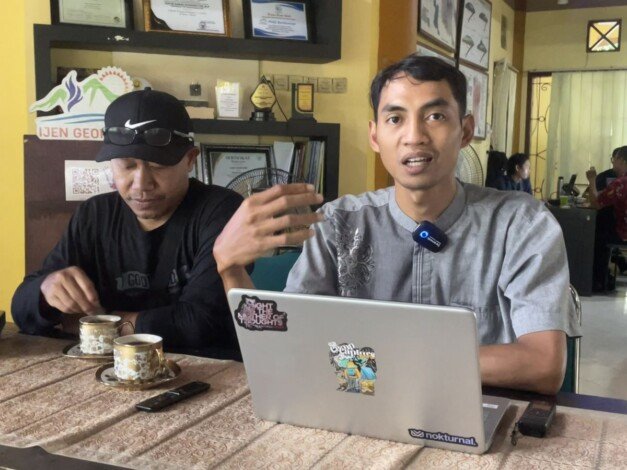
Delivered in a presentation meeting by Hosnul Wahid at Ijen-Geopark Bondowoso office. Before the great fracture occurred, the vast Ijen Caldera was once home to an ancient lake. At that time, the volcanic supply was increasing, yet the caldera had not split apart. The trapped water gradually formed a large and long-lived lake — what geologists now call the ancient lake of Ijen. Evidence of this lake still remains. Along the newer road near the current fault line, layers of white clay can be seen — the sediment left from that ancient body of water. Shells and mollusks from freshwater species have also been discovered there, a reminder that life once flourished on its shores. Around Belawan hot springs, near today’s Kalianyar village, traces of this prehistoric environment can still be found. The term “ancient” itself becomes a narrative bridge — not merely about age, but about geological storytelling. Depending…
From the Ancient Sea to the Rise of Volcanoes: The Birth of the Ijen Caldera (Part 2)
Delivered in a presentation meeting by Hosnul Wahid at Ijen-Geopark Bondowoso office. Roughly 30 million years ago, deep beneath what is now East Java, the earth began to move.The tectonic plates — those massive slabs of the earth’s crust — slowly collided and pushed against each other. Some plates were thick and heavy, others thin and flexible. When they met, the heavier plates were forced downward, sliding beneath the lighter ones. As these movements continued, the pressure and heat deep underground built up, and the molten rock — magma — began to seek a way to escape.That movement, that ancient pressure, was the birth of volcanoes. The Ancient Volcanoes of Southern Java If we look back to those times, many of Java’s earliest volcanoes formed along its southern coast — ancient giants that are now long extinct. Over millions of years, wind, rain, and sea waves eroded their peaks. What…
Understanding Ijen Geopark: The Earth’s Story (Part 1)
Delivered in a presentation meeting by Hosnul Wahid at Ijen-Geopark Bondowoso office. “What is a Geopark?” A Geopark is a kind of geographical model — an area based on its geological characteristics. It can stand alone as a single region — a district, a village, or a regency — or it can span across multiple regions, provinces, even countries.” That’s why we introduced Ijen Geopark, a vast geological park connecting two regencies on the eastern tip of Java: Bondowoso and Banyuwangi. Two different landscapes and cultures, united under one natural and geological heritage. The Earth as a Living Museum “Geopark literally means a park of the earth.”It is not merely a beautiful natural site but a place that preserves and celebrates geological heritage — the rocks, landforms, fossils, and the human civilizations shaped by them. Yet, a Geopark goes beyond geology. It also embraces biological heritage, biodiversity, and the way…