

As we step into the next era after the great volcanic eruptions, the stones that once told stories of fire and creation now whisper about human civilization — how people adapted, believed, and built their world upon ancient landscapes.
Bondowoso, as it turns out, preserves one of the most complete chains of civilization in East Java — from the Megalithic, Classic, Colonial, to the Modern era we live in today.
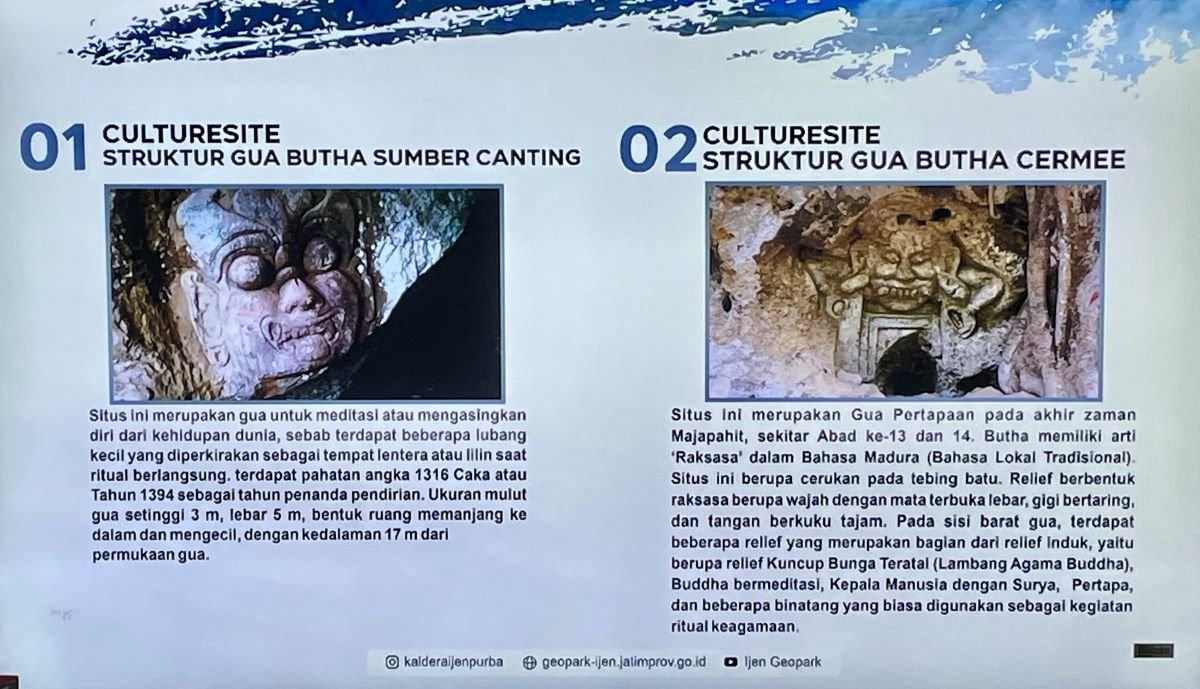
The Megalithic Legacy
The Megalithic period in Bondowoso is visible everywhere — through the countless sarcophagi, dolmen, kenong stones, and cylindrical stones scattered across its land.
Visit Grujugan or Pusat Informasi Majapahit (PIM) Museum in Bondowoso, and you’ll find these artifacts still standing, not as told in the classroom, but in their original soil — allowing visitors to touch history, to sense the craftsmanship carved by ancient hands.
These stones, locally known as Megalithic sites, hold more than archaeological value — they are the first written language of the earth, narrating how communities once lived, buried their dead, and worshipped the unseen forces of nature.
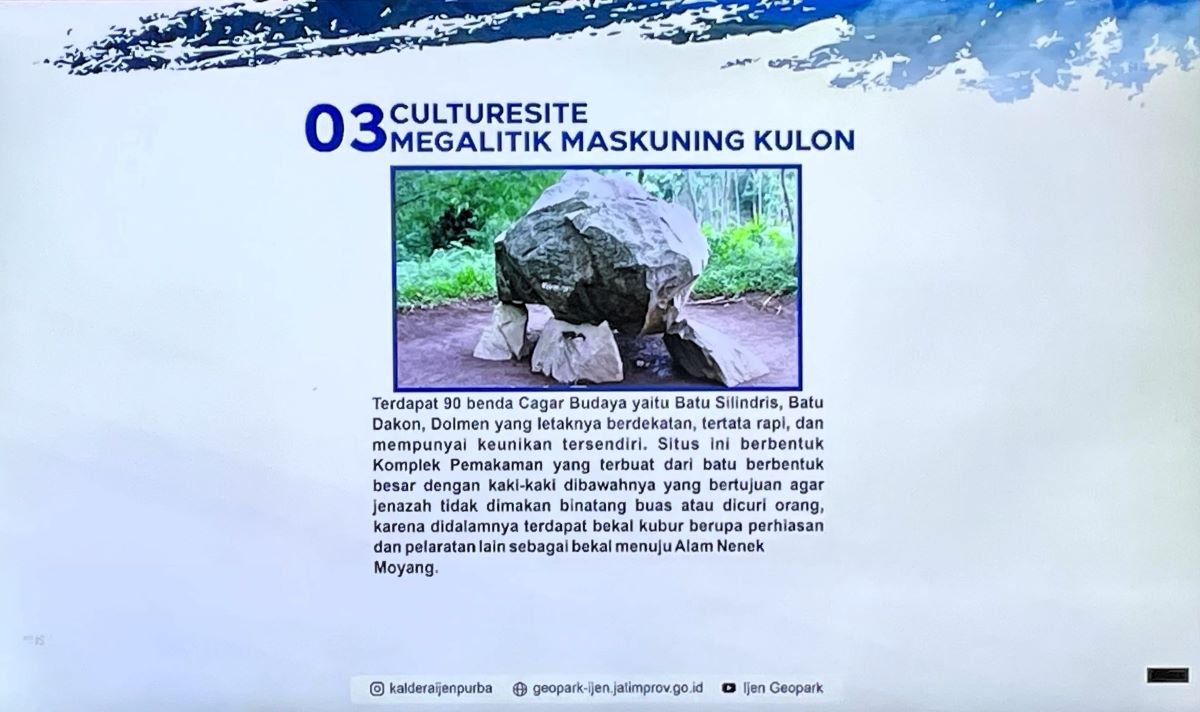
The Classical Age — Kingdoms and Influence
Then came the Classic era, the time of kingdoms. Bondowoso’s land carries traces of Majapahit’s influence, revealed through the discoveries of Gua Buto structures in Sumber Canting and Cerme.
Based on studies, these carvings date back to the 14th century (Saka year 1394) — a time when sacred art and spiritual practice merged into one.
Not far from there, in Pujer, ancient stones and stupas can still be found at the mountain’s foot — placed where large boulders naturally gathered after volcanic eruptions.
The ancients might have chosen these places for a reason: the mountain gave them stones, and they returned meaning to the mountain.
From Stones to Stories
The distribution of these sites tells us that life always flourished around volcanoes — not despite them.
The very eruptions that destroyed, also renewed. The fertile soils invited farming, and the stones became sanctuaries. This relationship between humans and volcanoes shaped not only landscapes but also beliefs — the beginning of Java’s sacred geography.
Coffee Cutivation: Bondowoso’s identity
Centuries later, as colonial powers arrived, the region saw another transformation — from sacred land to structured estates and plantations. The Dutch colonial era introduced systematic farming, especially coffee cultivation, which remains an important part of Bondowoso’s economy and identity today.
Even the Raung volcano, towering nearby, left its mark on civilization.
Researchers found brick structures buried under thick sediment layers near Jebung, suggesting that an ancient settlement once stood there before being covered by a massive eruption.
Historical records estimate this great eruption occurred around the 5th century — and another in the 16th century, coinciding with early European arrivals in the archipelago.
The Raung caldera, much like Ijen’s, formed through explosive collapse. Its dramatic landscape mirrors the turbulence of human history below — creation, destruction, and renewal.
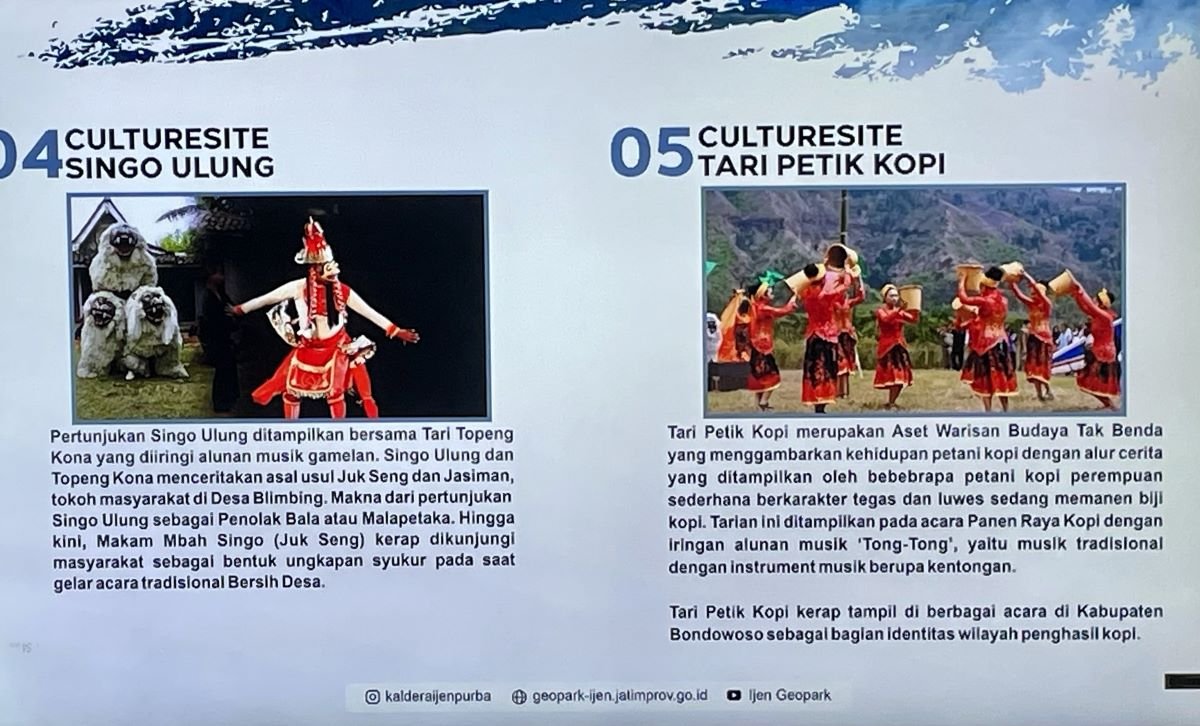
A Living Narrative
From the megalithic stones to the colonial plantations, every layer of Bondowoso tells a story.
Here, geology and anthropology are not separate fields — they intertwine.
As local guides often say, “The stones are alive; they remember.”
Each boulder, ridge, and caldera records not just eruptions but also prayers, rituals, and survival — the birth of civilization from beneath the volcano.