

Every stone tells a story — alive, ancient, and filled with memory.
In Ijen, the rocks are not silent. They speak of time, eruption, and rebirth.
If these stones are mined or destroyed, we might gain money, but we lose their stories forever. That is why the concept of Geotourism is so important. It allows us to conserve while earning, turning stories into shared value.
The Ijen Geopark embodies this philosophy. Its foundation lies in scientific research — studies by geologists and environmental scientists whose findings are then shared with local guides, educators, and communities.
Through storytelling based on these studies, every visitor becomes part of a living classroom. The result is a form of tourism that honors both science and local wisdom.
Kawah Wurung: The One-Breath Volcano
Among the fascinating sites is Mount Kawah Wurung, known as a monogenetic volcano — a volcano that lived through only one eruptive phase. Its conical shape still stands, yet it is no longer active. One explosion, one lifetime.
Today, the site symbolizes geological peace — the calm after creation — and offers a stunning panoramic landscape shaped by nature’s once-violent breath.
The Warm Embrace of the Earth
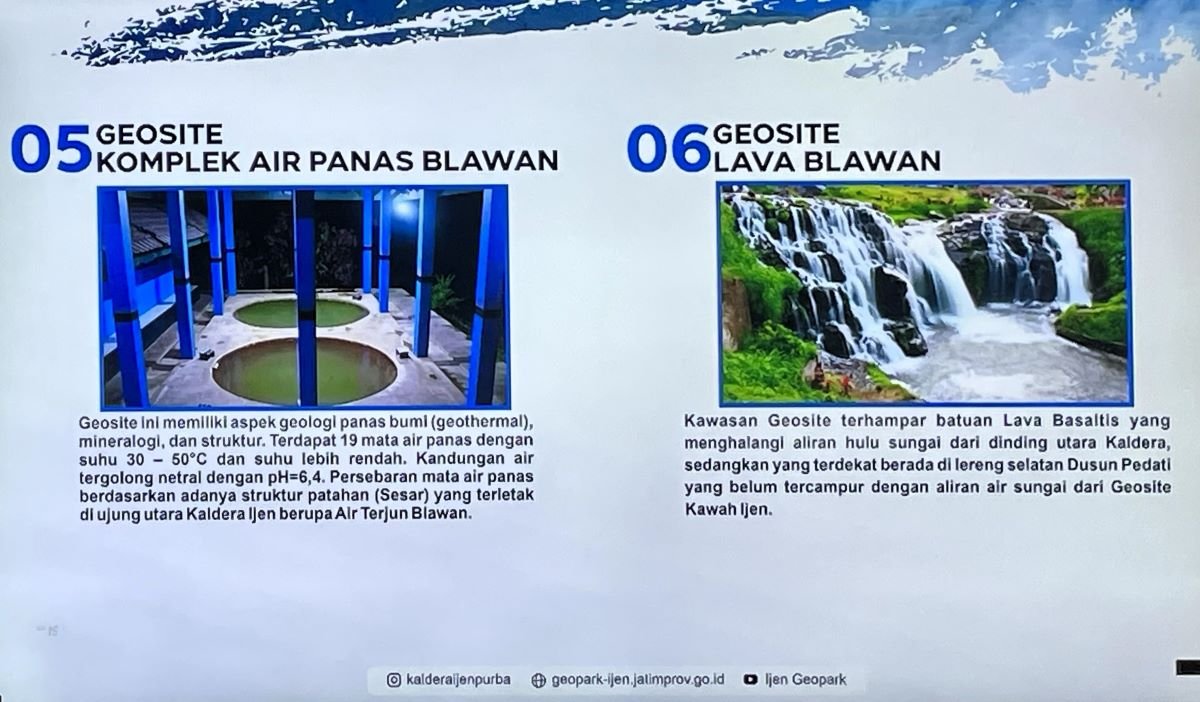
The Ijen region also holds rich geothermal potential. Natural hot springs flow through Belawan and surrounding valleys, carrying underground heat — Earth’s quiet energy.
In countries like Japan, these geothermal springs are turned into luxury wellness experiences, like onsen spas. Yet in Ijen, the same phenomenon occurs naturally — a perfect place to relax after trekking the volcano, soaking in the warmth of the living mountain beneath.
These hot waters remind us that Ijen is not extinct — its underground “stove” still burns.
The planet breathes here, offering warmth, minerals, and healing.
From Lava to Life
At Plalangan near Sempol, one can still see the traces of Ijen’s last lava flow — the Basaltic Lava of Plalangan. At the northen side, at Megasari, the landscape rises sharply, revealing layers of welded tuff and hardened ash. This natural architecture was shaped by pressure and heat during explosive eruptions.
The stronger materials stayed tall like cliffs, while weaker sediments eroded into river valleys — creating today’s striking contrasts of ridges and ravines.
The Biosite: Forests, Farmers, and Coffee
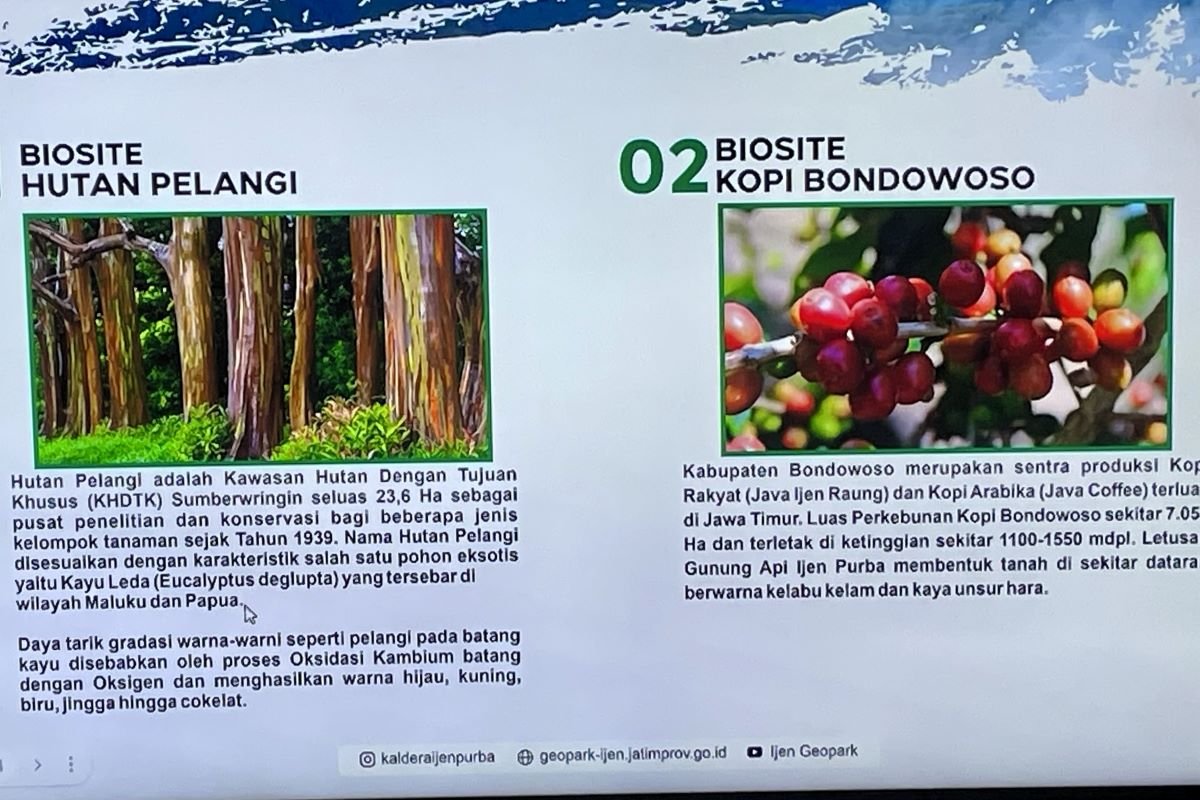
Beyond its fiery heart, Ijen is also fertile and green. Its biosites — such as the forest research zones in the KHTK (Kawasan Hutan Tujuan Khusus) area — hold a living record of biodiversity and conservation.
Here grows the rainbow tree (Eucalyptus deglupta, locally called leda), native to Papua and the Maluku Islands. These trees were planted in 1939 as part of long-term ecological research and are now maintained by the Forestry Research Center in Yogyakarta and IPB Bogor.
The volcanic soil of Bondowoso, enriched by centuries of eruptions, nurtures vibrant life.
It’s no wonder that coffee thrives here — the aroma and flavor of Ijen’s Arabica owe much to the minerals beneath.
Local farmers in areas like Kluncing (800 m) continue the legacy, combining tradition and tourism. Visitors often end their Ijen journeys here — sharing a cup of coffee grown on volcanic land while listening to stories of the mountains that shaped it.