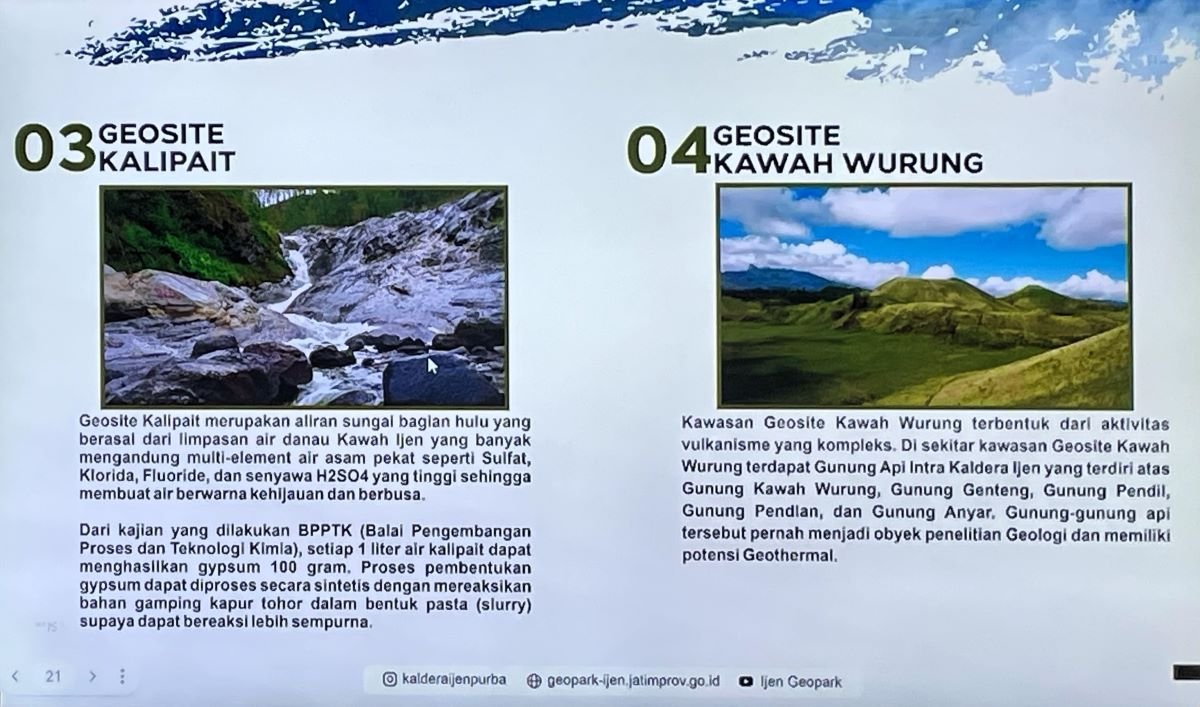

Delivered in a presentation meeting by Hosnul Wahid at Ijen-Geopark Bondowoso office.
Before the great fracture occurred, the vast Ijen Caldera was once home to an ancient lake. At that time, the volcanic supply was increasing, yet the caldera had not split apart. The trapped water gradually formed a large and long-lived lake — what geologists now call the ancient lake of Ijen.
Evidence of this lake still remains. Along the newer road near the current fault line, layers of white clay can be seen — the sediment left from that ancient body of water. Shells and mollusks from freshwater species have also been discovered there, a reminder that life once flourished on its shores. Around Belawan hot springs, near today’s Kalianyar village, traces of this prehistoric environment can still be found.
The term “ancient” itself becomes a narrative bridge — not merely about age, but about geological storytelling. Depending on how far one looks back, the Ijen Caldera’s story connects to the ages such as the Pleistocene, Mesolithic, and Neolithic — those marked by intense volcanic activity that shaped the Earth and, at times, erased entire existances.
During these phases, massive eruptions darkened the skies, blocking sunlight and triggering dramatic climate shifts — even ice ages. The Earth was, in a sense, recalibrating itself.
Today, this region stands as a living classroom of that ancient drama. The Ijen complex hosts a cluster of “child volcanoes” — Lingker, Jampit, Anyar, Widodaren, Ranti, Merapi, Suket, Pendil, Gending Waluh, and Ringgih, among others (complete are 22 mountains). Together, they form a single geological family — the descendants of the great Ijen Caldera.
These mountains and sites are now part of a growing list of geological and biological wonders under the Ijen Geopark. They include famous points like the Ijen Crater Lake, the Blue Flame, Watu Dodol, Kawah Wurung, Kali Pahit, Belawan Hot Spring, and Basaltic Lava fields — all tied to the same volcanic origin story.
Other significant sites such as the Pandawa Terraces in Botolinggo subdistrict, display giant boulders — frozen witnesses of Ijen’s ancient eruptions.
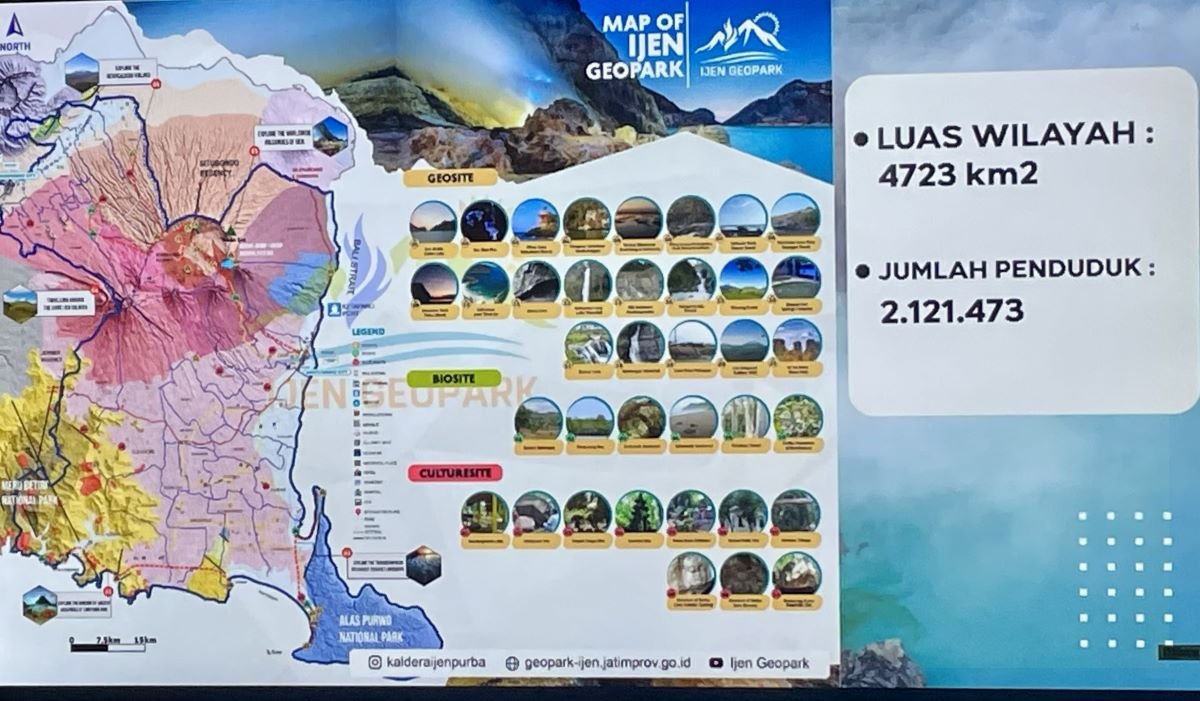
Ijen Geological Icons
Within the Geopark, two features stand as its geological icons: the Ijen Crater and its Blue Flame phenomenon. The crater lake collects water from the surrounding slopes, but due to its high sulfur content, its pH reaches extreme acidity — sometimes recorded at 0.00 on measurement devices. Any metal or calcium-based object touching the water will corrode instantly.
The Blue Flame itself is another natural marvel, a result of sulfuric gas ignition under immense heat and pressure — an ongoing reminder that Ijen remains alive beneath its surface.
Meanwhile, the nearby Kali Pahit stream showcases another geological masterpiece — columnar joint formations, also known as seating joints. These layers are created when liquid lava slowly cools and solidifies in repeated cycles, forming thin stacked sheets of volcanic rock. Each layer tells of a time when molten earth met the cool air — a natural sculpture shaped over millennia.
Unfortunately, some of these formations have been scarred by human vandalism — a loss for both science and heritage. Yet, for those who come with respect and curiosity, Ijen continues to whisper its story — from its ancient lake and vanished civilizations to the living fire that still breathes beneath the mountain.