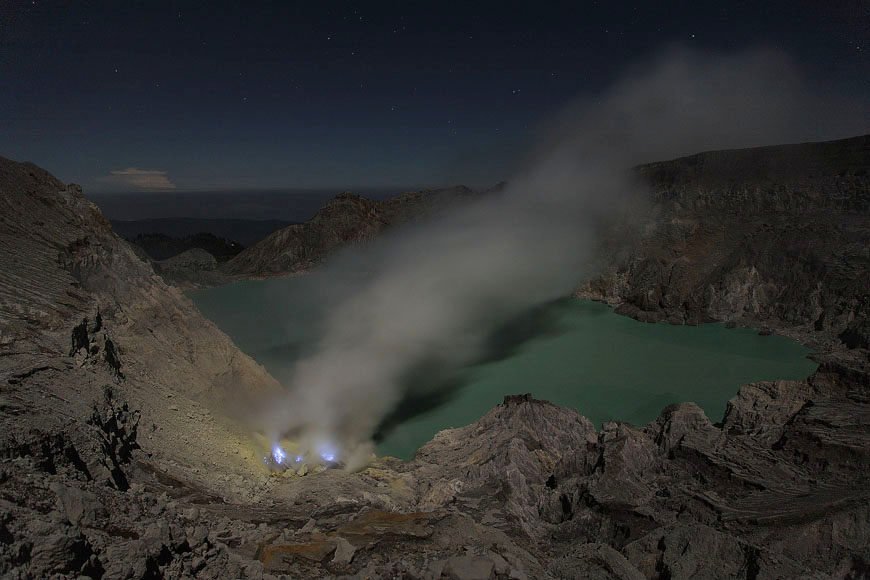
Ijen Crater is not only a popular natural tourist destination, but also home to around 400 sulfur miners. This active volcano contains a massive sulfur deposit and offers a magnificent view of a turquoise-colored crater lake. Visitors can often meet the miners who carry heavy loads of sulfur on their shoulders. On average, they walk up and down the mountain twice a day, carrying between 50 to 100 kilograms per trip. Most of them come from villages located at the foot of Mount Ijen and make a living by carrying sulfur every day. I am one of them — I have been doing this work since 1990.
When I first started as a miner, I had to walk about 18 kilometers a day. Back then, in the early 1990s, I carried sulfur from the crater all the way down to Tamansari Village. Between 1990 and 1994, there was no road access, so everything had to be done on foot. Later, a new road was built so trucks could reach the weighing station near the protected forest area in Sadang, around 1996. Gradually, the local government extended the road up to Paltuding, which remains the main access point today.
There were times I suffered injuries and illnesses from this work. I once fell, became seriously sick, and had lung problems that made it hard to breathe. Despite these challenges, all the pain seems to disappear whenever I enjoy the beauty of Ijen.
I have spent much of my life around this volcano, and I’m always amazed by its natural beauty. Looking west, you can see the sunrise over the Argopuro mountain range, behind the majestic summit of Mount Raung and the vast Wurung Crater. To the southeast, you can enjoy clear views of the Besuki coastline, Baluran Mountain, and the Bali Strait.
There’s also a rarely visited area to the west of the crater. If you go down the cliff, you’ll find a cave surrounded by colorful rocks — red, black, green, and white limestone or gypsum crystals. Another unique sight is a group of white crystalline rocks that shine brightly in the sunlight, reflecting shades of white and yellow. I discovered this place by accident while guiding a tourist named Mark from America. From that spot, you can see the dam and the wide expanse of the crater surface.
At night, Ijen reveals another secret beauty — the famous blue flame. This rare phenomenon occurs when sulfuric gas ignites as it escapes from cracks in the volcano, glowing bright blue against the dark landscape and reflecting on the calm surface of the crater lake. These flames are best seen from the southeast or north sides.
At the same time, you can witness the miners beginning their nightly work. Carrying torches made from plastic bottles filled with kerosene and coconut-husk wicks, they climb up and down the crater in the dark. By early morning, the cold mountain air wraps around your body, but it’s soon replaced by the warmth of the first sunlight and the cheerful song of Cucak birds. Even though I’ve been here countless times, I always find something new to discover.
As a miner, I’ve also seen many surprising things in the surrounding forest. Once, I encountered a wild black tiger with its cub. Another time, I saw monkeys with red, orange, and white fur. That’s why I believe Ijen is not only a place of stunning scenery but also an important habitat for rare wildlife.